

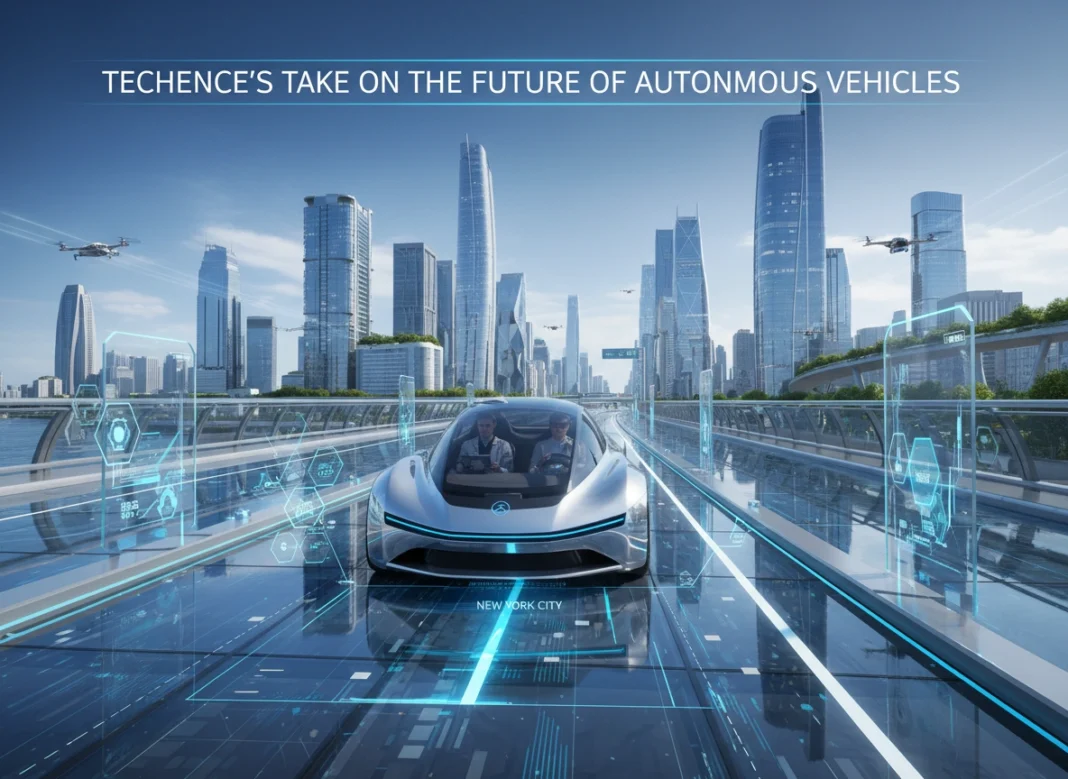
The idea of cars that drive themselves has long been a fixture of science fiction, but it is rapidly becoming a reality. Autonomous vehicles (AVs) represent one of the most significant technological shifts of our time, promising to redefine transportation, urban planning, and daily life. At Techhence, we see this evolution not just as an engineering challenge but as a complex interplay of artificial intelligence, connectivity, and human-centric design. This article explores our perspective on the advancements, hurdles, and profound potential of the autonomous future.
We will cover the key technological drivers pushing this industry forward, from advanced AI to the Internet of Things (IoT). We will also examine the substantial challenges that remain, including regulatory frameworks and public trust. Finally, we will look ahead to the transformative impacts these vehicles will have on our society, economy, and environment.
The Technological Backbone of Autonomy
The journey to full self-driving capability is not a single leap but a progression through defined levels of automation. The industry generally follows the SAE International levels, from Level 0 (no automation) to Level 5 (full automation in all conditions). While many modern vehicles feature Level 1 or 2 driver-assist systems, the push toward Levels 4 and 5 is where the true revolution lies. This progress is fueled by a convergence of powerful technologies.
AI and Machine Learning: The Brains of the Operation
At the core of every autonomous vehicle is a sophisticated artificial intelligence system. This AI acts as the central nervous system, processing vast amounts of data to make real-time decisions. Machine learning (ML), a subset of AI, is what makes these systems truly intelligent. ML models are trained on massive datasets containing billions of miles of driving data, both from real-world driving and advanced simulations.
This training enables the vehicle to recognize pedestrians, interpret traffic signals, predict the behavior of other drivers, and navigate complex road scenarios. At Techhence, we believe the next frontier for AV AI is enhancing its ability to handle “edge cases”—rare and unpredictable events that fall outside standard driving situations. This requires a move from simple pattern recognition to a more nuanced, context-aware understanding of the world, akin to human intuition.
Sensor Fusion: Creating a 360-Degree Worldview
An autonomous vehicle “sees” the world through an array of advanced sensors. No single sensor is sufficient; instead, the vehicle relies on a technique called sensor fusion to create a comprehensive and redundant perception of its environment.
- LiDAR (Light Detection and Ranging): LiDAR uses laser pulses to create a detailed, three-dimensional map of the vehicle’s surroundings. It excels at measuring distances with high precision, making it crucial for object detection and localization.
- Cameras: High-resolution cameras provide rich visual information, allowing the AI to identify colors, read road signs, and recognize lane markings. They are essential for understanding the context of a scene.
- Radar: Radar systems use radio waves to detect objects and measure their velocity. They are highly effective in adverse weather conditions like rain, fog, or snow, where cameras and LiDAR might struggle.
By fusing data from these different sources, the AV can build a robust and reliable model of its environment, cross-referencing information to ensure accuracy and safety.
IoT and V2X Communication: The Connected Ecosystem
A truly autonomous future is not just about individual smart cars; it is about a connected transportation ecosystem. The Internet of Things (IoT) is the framework that allows vehicles to communicate with each other and with the world around them. This is known as Vehicle-to-Everything (V2X) communication.
V2X technology enables a vehicle to receive information far beyond the range of its onboard sensors. For example, a car could receive a signal from a traffic light that it is about to turn red, or get an alert from a vehicle several cars ahead that has suddenly braked. This flow of information creates a cooperative driving environment, enhancing safety and improving traffic efficiency. Techhence envisions a future where smart cities and autonomous vehicles are deeply integrated, with infrastructure and vehicles sharing data seamlessly to optimize traffic flow and prevent accidents before they happen.
Navigating the Roadblocks to Adoption
Despite rapid technological progress, the path to widespread autonomous vehicle adoption is filled with significant challenges. These hurdles are not just technical; they are also regulatory, ethical, and societal.
The Regulatory and Legal Maze
One of the greatest obstacles is the lack of a clear and consistent regulatory framework. Laws governing vehicles were written for human drivers, and adapting them for autonomous systems is a complex task. Questions of liability are paramount: in the event of an accident involving an AV, who is responsible? The owner, the manufacturer, the software developer, or the fleet operator? Governments worldwide are grappling with these issues, and progress toward standardized regulations has been slow. Establishing clear legal precedent is essential for building industry confidence and ensuring a smooth rollout.
Ensuring Safety and Building Public Trust
For autonomous vehicles to succeed, the public must trust them. High-profile accidents involving semi-autonomous systems have fueled public skepticism and highlighted the immense responsibility on manufacturers to ensure safety. The standard for AV safety cannot just be equal to human drivers; it must be demonstrably superior.
Achieving this requires rigorous testing, validation, and transparency. The industry must prove that its systems are reliable in all conditions. This involves not only billions of miles of testing but also developing robust cybersecurity measures to protect vehicles from malicious attacks. Building public trust is a gradual process that will depend on a proven track record of safety and reliability.
The Ethical Dilemmas
Autonomous vehicles will inevitably face scenarios where an accident is unavoidable. In these situations, the vehicle’s AI may be forced to make a choice between two negative outcomes—a modern-day “trolley problem.” Should the car prioritize the safety of its occupants over pedestrians? Should it choose to hit one person to avoid hitting a group of people?
These are not just philosophical questions; they are programming challenges that require a clear ethical framework. There is no global consensus on how these dilemmas should be resolved. At Techhence, we advocate for a transparent, industry-wide approach to developing ethical guidelines, ensuring that these life-or-death decisions are not made in a black box but are based on clearly defined and publicly accepted principles.
The Transformative Impact of Autonomous Mobility
The successful integration of autonomous vehicles promises to reshape our world in profound ways, offering substantial benefits across society, the economy, and the environment.
Societal and Lifestyle Changes
Widespread adoption of AVs could dramatically improve quality of life. For the elderly and people with disabilities, autonomous mobility offers newfound freedom and independence. Commuters will be able to reclaim hours lost in traffic, using their travel time for work, relaxation, or entertainment. This “passenger economy” will create new markets for in-vehicle services and content.
Furthermore, AVs have the potential to make our roads significantly safer. With human error responsible for the vast majority of traffic accidents, replacing human drivers with vigilant, non-distracted AI could save hundreds of thousands of lives each year.
Economic and Environmental Opportunities
The economic impact will be far-reaching. The logistics and shipping industries will be transformed by autonomous trucks operating 24/7, leading to faster, cheaper, and more efficient supply chains. Urban areas may see a decline in the need for parking spaces, freeing up valuable real estate for parks, housing, and commercial development.
From an environmental standpoint, shared autonomous electric vehicles could play a key role in reducing emissions and traffic congestion. Optimized driving patterns, platooning on highways, and efficient routing can significantly decrease energy consumption. A shift away from personal car ownership toward on-demand autonomous mobility services could lead to fewer cars on the road, further reducing the overall environmental footprint of transportation.
A Forward-Looking Perspective from Techhence
The road to a fully autonomous future is complex, but the destination is worth the journey. At Techhence, we are committed to advancing the technologies that will make this vision a reality. We believe the key lies in a holistic approach that prioritizes not only technological innovation but also safety, ethical considerations, and human-centric design.
The integration of autonomous vehicles will be gradual, likely beginning with robo-taxis in designated urban zones and long-haul trucking on highways. As the technology matures and public confidence grows, we will see AVs become an increasingly common feature in both urban and rural landscapes. The future of mobility is not just about self-driving cars; it is about creating a safer, more efficient, and more connected world for everyone. The journey has just begun, and we are excited to be at the forefront of shaping it.