

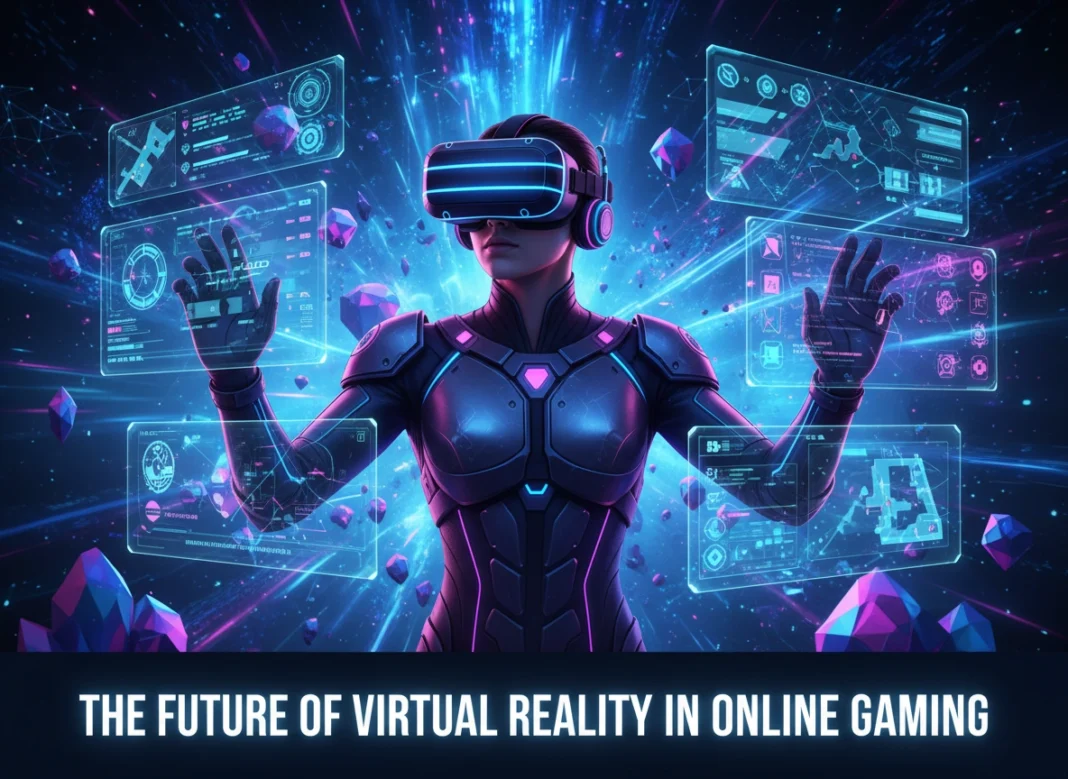
Imagine stepping into a game where you aren’t just controlling a character on a screen, but you are the character. The wind whistles past your ears as you scale a digital mountain, and you can physically turn your head to see a teammate signaling you from a ridge. This isn’t a scene from a science fiction novel; it is the rapidly evolving reality of online gaming.
For years, Virtual Reality (VR) felt like a perpetual “next big thing”—always promising, but never quite arriving. That narrative has shifted. We are no longer waiting for VR to arrive; we are watching it mature. As hardware becomes more powerful and developers grow more ambitious, VR is poised to transform online gaming from a passive pastime into a fully immersive existence.
In this article, we will explore how VR is reshaping the gaming landscape, the technological leaps driving this change, the hurdles we still need to clear, and what the next decade of virtual worlds might look like.
The Current State of VR Gaming: Beyond the Gimmick
Early VR experiences were often short, tech-demo style encounters. You might have walked through a virtual museum or shot stationary targets in a gallery. While novel, these experiences lacked depth. Today, the landscape is vastly different.
Modern VR gaming offers robust, full-length titles that rival traditional console games in scope and complexity. Games like Half-Life: Alyx set a new benchmark, proving that VR could support high-fidelity, narrative-driven campaigns. In the online sphere, titles like VRChat and Rec Room have created massive social ecosystems where millions of users interact daily.
The current market is defined by a split between high-end, PC-tethered headsets (like the Valve Index) and accessible, standalone units (like the Meta Quest series). The success of standalone units has been particularly crucial. By removing the need for expensive gaming PCs and tangled wires, VR has finally found a foothold in the mainstream consumer market.
Technological Advancements Driving Immersion
The leap from “looking at a screen” to “being inside the game” relies on several key technological pillars. These advancements are what make the future of VR so promising for online gaming.
Higher Fidelity and Eye Tracking
Pixelation and the “screen door effect” (where you can see the gaps between pixels) were major complaints in early headsets. Newer displays offer 4K resolution per eye, making virtual worlds crisp and believable. Furthermore, eye-tracking technology allows for “foveated rendering.” This technique renders high-quality graphics only where the user is looking, saving processing power and allowing for even more detailed environments without melting the hardware.
Haptic Feedback: Feeling the Game
Visuals are only half the battle. Immersion breaks if you reach out to touch a wall and feel nothing. Haptic feedback technology is advancing rapidly. Beyond simple controller vibrations, we are seeing the development of haptic suits and gloves. These devices can simulate the sensation of raindrops, the recoil of a weapon, or the resistance of a heavy object. In an online RPG, this means you could actually feel the weight of the sword you are swinging.
5G and Cloud Gaming
For online VR to truly thrive, latency must be eliminated. In a fast-paced shooter, a millisecond of lag can cause motion sickness or a lost match. The rollout of 5G networks and edge computing is solving this. By processing heavy graphical data in the cloud and streaming it instantly to a lightweight headset, we can achieve high-fidelity gaming without bulky hardware strapped to our faces.
Revolutionizing Social Interaction and Player Engagement
The most profound impact of VR on online gaming is social. Traditional online gaming relies on voice chat and avatars on a flat screen. VR introduces body language, proximity, and eye contact into the digital realm.
A New Level of Presence
In a VR poker game, you can see your opponent lean back in their chair or nervously tap their fingers. In a tactical shooter, you can hand a clip of ammo to a teammate physically rather than pressing a button. This sense of “presence”—the feeling that you are physically sharing a space with another person—creates stronger emotional bonds between players.
The Evolution of Digital Spaces
We are moving away from game lobbies and toward virtual “hangout” spaces. Platforms like VRChat demonstrate that players often value the social lobby as much as the game itself. The future of online gaming will likely blur the line between social media and gameplay, creating persistent virtual worlds (often called the Metaverse) where players live, work, and play together.
Challenges on the Horizon
Despite the optimism, significant barriers remain. VR is not yet ubiquitous, and several hurdles must be cleared before it becomes the standard for online gaming.
The Cost of Entry
While standalone headsets have lowered the price, VR is still an expensive hobby. A high-quality setup can cost upwards of $500 to $1,000. For online gaming communities to thrive, the player base needs to be massive. High costs limit the pool of potential players, making it risky for developers to invest millions in multiplayer-only VR titles.
Motion Sickness and Physical Fatigue
“VR legs” is a real term for a reason. Many players still experience nausea when moving artificially in a virtual space. Additionally, VR gaming is physically demanding. Standing, ducking, and swinging arms is great exercise, but it limits the duration of play sessions. You can lounge on a couch playing a console game for four hours; doing the same in an active VR shooter is exhausting. Developers need to find a balance between immersion and comfort.
Hardware Form Factor
Wearing a computer on your face is inherently intrusive. Current headsets can be heavy, hot, and uncomfortable after an hour. The “sunglasses” form factor is the holy grail—lightweight, stylish glasses that offer full VR capabilities. We are years away from this being commercially viable for high-end gaming, but it is the necessary end goal for mass adoption.
Future Trends: What the Next Decade Holds
Looking ahead, the convergence of VR with other emerging technologies paints a fascinating picture for online gaming.
AI-Driven Worlds
Artificial Intelligence will populate these virtual worlds. Imagine NPCs (non-player characters) that don’t just recite scripted lines but can hold dynamic conversations, remember your past interactions, and react emotionally to your presence. In an online VR MMORPG, the world will feel alive even when other human players aren’t around.
Cross-Platform Integration
Currently, the VR ecosystem is fragmented. A Quest player often cannot play with a PlayStation VR player. The future lies in seamless cross-play. Furthermore, asymmetric gaming—where a VR player interacts with PC or console players in the same game—will become more common. Imagine a game where the VR player is a giant monster destroying a city, while PC players are the tiny soldiers on the ground trying to stop them.
Brain-Computer Interfaces (BCI)
This sounds like pure science fiction, but research is already underway. BCI could eventually allow us to control virtual avatars with our thoughts, bypassing physical controllers entirely. While this is likely decades away from mainstream gaming, it represents the ultimate horizon of immersion.
Conclusion
The future of virtual reality in online gaming is not about replacing traditional gaming; it is about expanding the definition of play. We are moving from observing digital worlds to inhabiting them.
The technology has matured past the experimental phase. We now have the resolution, the processing power, and the creative vision to build truly transformative experiences. While challenges like cost and comfort remain, the trajectory is clear. As haptics improve, headsets shrink, and internet speeds increase, the barrier between the physical and the digital will continue to dissolve.
In the next decade, we won’t just be logging on to a game. We will be logging in—stepping through a digital doorway into worlds where the only limit is our imagination. The game has changed, and it is time to suit up.
Please visit this website for more info.