

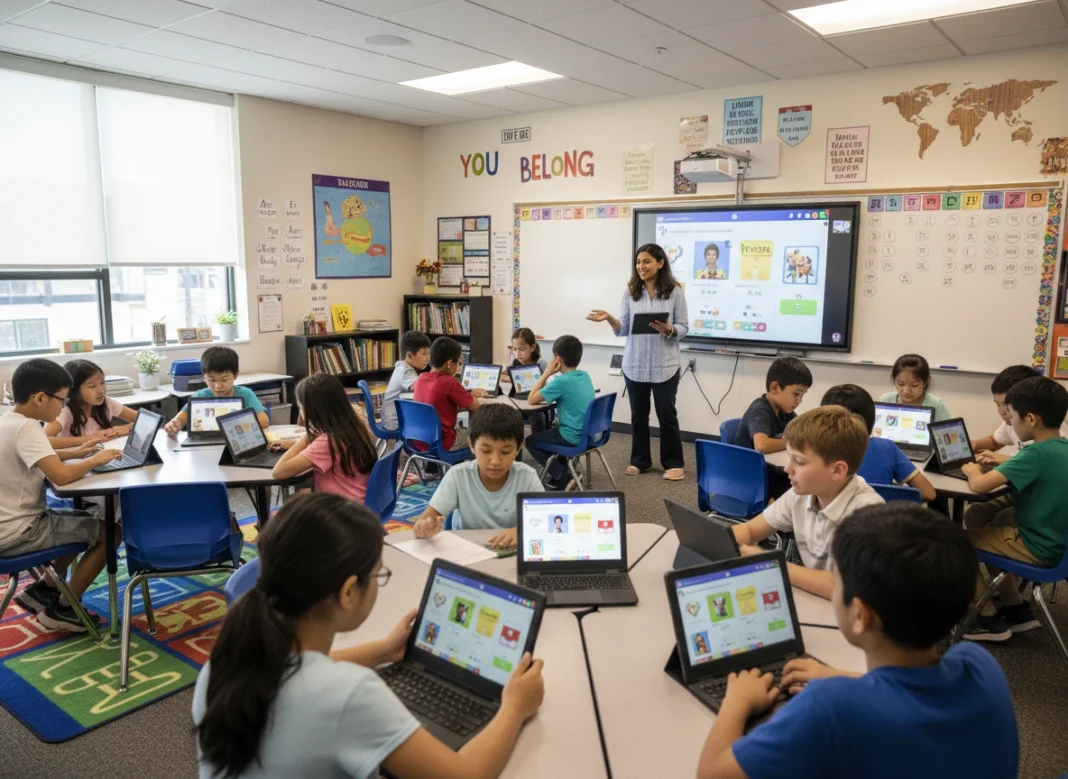
Every teacher knows the feeling. You scan your classroom and see twenty-five distinct individuals staring back. One student finished the assignment ten minutes ago and is bored. Another is struggling to decode the first sentence. A third understands the concept perfectly but panics during traditional tests.
This is the reality of the diverse classroom. It is a beautiful mosaic of abilities, backgrounds, and learning styles, but it presents a monumental challenge: how do you teach everyone effectively at the same time?
This is where differentiated learning becomes essential, and where educational technology tools like Gimkit are changing the landscape. While many EdTech platforms offer simple quizzes, Gimkit provides a unique ecosystem that empowers educators to tailor instruction without tripling their workload.
In this article, we will explore how Gimkit’s specific features—from its economy-based gamification to its robust data tracking—serve as powerful levers for differentiation in modern classrooms.
Understanding the Challenge of Diverse Classrooms
Before diving into solutions, we need to acknowledge the complexity of the problem. A “diverse classroom” isn’t just about cultural background; it encompasses neurodiversity, varying processing speeds, language proficiency levels (ELLs), and different levels of prior knowledge.
Differentiation is the pedagogical response to this diversity. It asks teachers to adjust their content, process, product, and learning environment. However, differentiation is often time-consuming. Creating three versions of every worksheet or designing four different assessment types for a single unit is a recipe for teacher burnout.
Technology needs to step in not just as a delivery method, but as a differentiation engine. This is the gap Gimkit fills.
The Gimkit Advantage: More Than Just a Quiz
Gimkit was created by a high school student who felt disengaged by traditional review games. The result is a platform that feels less like a test and more like a strategy game. Students answer questions on their own devices at their own pace to earn in-game cash, which they can then spend on upgrades and power-ups.
This core mechanic—earning currency to buy advantages—is the secret sauce for differentiation. It shifts the focus from “getting the right answer to please the teacher” to “getting the right answer to achieve a personal goal.”
Feature 1: Self-Paced Repetition
One of the biggest hurdles in a diverse classroom is processing speed. In a traditional “everyone looks at the smartboard” review game, the fastest readers dominate. Students who need a moment to think or translate a term in their head often check out because they know they can’t compete.
Gimkit solves this through asynchronous, self-paced play within a live setting.
- The Mechanism: Questions repeat. If a student gets a question wrong, the correct answer is shown, and that question will appear again later in the session.
- Differentiation Impact: This creates a safe failure loop. A student who struggles with retention gets multiple “at-bats” on the same concept without public shaming. Meanwhile, advanced students can move rapidly through the questions, focusing on maximizing their in-game currency strategy. Both students are engaged, but they are experiencing the content at a rhythm that suits their cognitive load.
Feature 2: The “KitCollab” and Student Agency
Engagement is a critical component of differentiation. Students who feel disconnected from the material are harder to reach. Gimkit’s “KitCollab” mode allows students to write the questions themselves.
- The Scenario: Imagine a history class reviewing the Civil War. Instead of the teacher writing all the questions, students are assigned to write one question each.
- Differentiation Impact:
-
- Advanced Learners: Can be challenged to write higher-order thinking questions (e.g., “What was the primary economic consequence of the blockade?”).
- Struggling Learners: Can focus on recall questions or defining key terms.
- ELL Students: Can contribute questions that focus on vocabulary or visual identification.
By allowing students to contribute to the assessment, the teacher validates different levels of understanding while ensuring the entire class benefits from a comprehensive review.
Gamification Modes as Learning Scaffolds
Gimkit is famous for its various game modes. These aren’t just aesthetic skins; they are distinct frameworks that support different social and emotional needs.
Collaborative vs. Competitive
Some students thrive on competition; others shut down in the face of it. Gimkit offers modes like “The Floor is Lava” or “Trust No One” alongside classic team modes.
- Cooperative Modes: In modes where the class must work together to survive or reach a goal, stronger students naturally scaffold for struggling students. They shout out tips, share in-game resources, or strategize together. This peer-to-peer teaching is a high-impact differentiation strategy that happens organically within the game.
- Low-Stakes Environment: Because students can buy “insurance” or upgrades that multiply their earnings, a student who starts slow isn’t permanently behind. A few correct answers later in the game, combined with a smart upgrade purchase, can catapult a struggling student to the top of the leaderboard. This keeps motivation high for everyone, regardless of their initial proficiency.
Customization: Tailoring the Content
The true power of differentiation lies in the teacher’s ability to control exactly what is presented. Gimkit offers granular control that supports Targeted Instruction.
Assigning Homework and Independent Practice
Gimkit isn’t just for live class time. Teachers can assign “Kits” as homework.
- Targeted Assignments: A teacher can create three versions of a math review Kit.
-
- Group A (Needs Support): Focuses on foundational skills with simpler integers.
- Group B (On Level): Standard curriculum questions.
- Group C (Extension): Word problems and multi-step equations.
- The Student Experience: Students access the link assigned to them. They play the game mechanics they love, but the academic content is perfectly keyed to their Zone of Proximal Development (ZPD). They aren’t frustrated by impossible questions, nor are they bored by easy ones.
Visual and Audio Support
For diverse classrooms including students with visual impairments or reading difficulties, Gimkit integrates Immersive Reader. This Microsoft tool can read text aloud, break words into syllables, and even translate text into different languages.
This is a massive differentiator for English Language Learners (ELLs). They can participate in the same game as their peers, using the tool to bridge the language gap in real-time without needing a teacher to stand over their shoulder translating every question.
Data-Driven Decisions: The Feedback Loop
You cannot differentiate effectively if you don’t know what your students know. Gimkit provides detailed reports immediately after a game ends.
The “Student Needs Help” Feature
The most valuable report is arguably the breakdown of individual student performance. It highlights not just who won the game, but specifically which questions were missed most frequently.
- Identifying the Gap: If the data shows that 40% of the class missed questions about “photosynthesis,” but aced questions about “cellular respiration,” the teacher knows immediately where to direct the next mini-lesson.
- Individual Intervention: The reports allow teachers to see individual student trails. If a specific student answered 50 questions but only got 10 correct, the teacher can intervene privately. Conversely, if a student answered 100 questions with 98% accuracy, the teacher knows that student needs enrichment material next time.
This real-time data transforms differentiation from a guessing game into a precise science.
Real-World Scenario: The 7th Grade Science Class
Let’s look at how this plays out in practice.
Mrs. Rodriguez teaches 7th-grade science. Her class includes three students on IEPs for reading disabilities, five ELL students, and four students identified as “gifted.”
- Preparation: Mrs. Rodriguez creates a Gimkit set on “Ecosystems.” She adds images to every question to support her ELL students and poor readers.
- The Session: She launches “Fishtopia,” a mode where students answer questions to catch fish.
- During Play:
-
- The gifted students race through questions to buy advanced fishing rods. They are engaged by the strategy of the economy.
- The students with IEPs use the Immersive Reader function to have questions read to them. They take their time. Because questions repeat, they eventually master the definitions through low-stress repetition.
- Mrs. Rodriguez walks around. She sees one student stuck on a specific concept. She provides a quick 30-second explanation. The student nods, answers correctly on the next loop, and earns their cash.
- Post-Game: Mrs. Rodriguez pulls the report. She sees the whole class struggled with the concept of “parasitism.” She decides to start tomorrow’s lesson with a specific video on parasitism to re-teach that concept to the whole group, while assigning a more complex project to the four gifted students who already mastered it.
In this 20-minute session, every single student was challenged, supported, and assessed.
Conclusion: The Future of Inclusive Education
Tools like Gimkit represent a shift in how we view educational equity. Differentiation is no longer about separating students into different rooms or giving them entirely different packets. It is about using technology to create a shared experience where every student can find their own foothold.
Gimkit supports diverse classrooms not by watering down content, but by providing multiple entry points. Whether through self-paced repetition, audio support, cooperative gameplay, or strategic data tracking, it allows teachers to meet students exactly where they are.
As classrooms continue to grow more diverse, the ability to scale personalized instruction will define the success of modern education. Platforms that combine the engagement of gaming with the precision of pedagogical best practices are leading the way.