

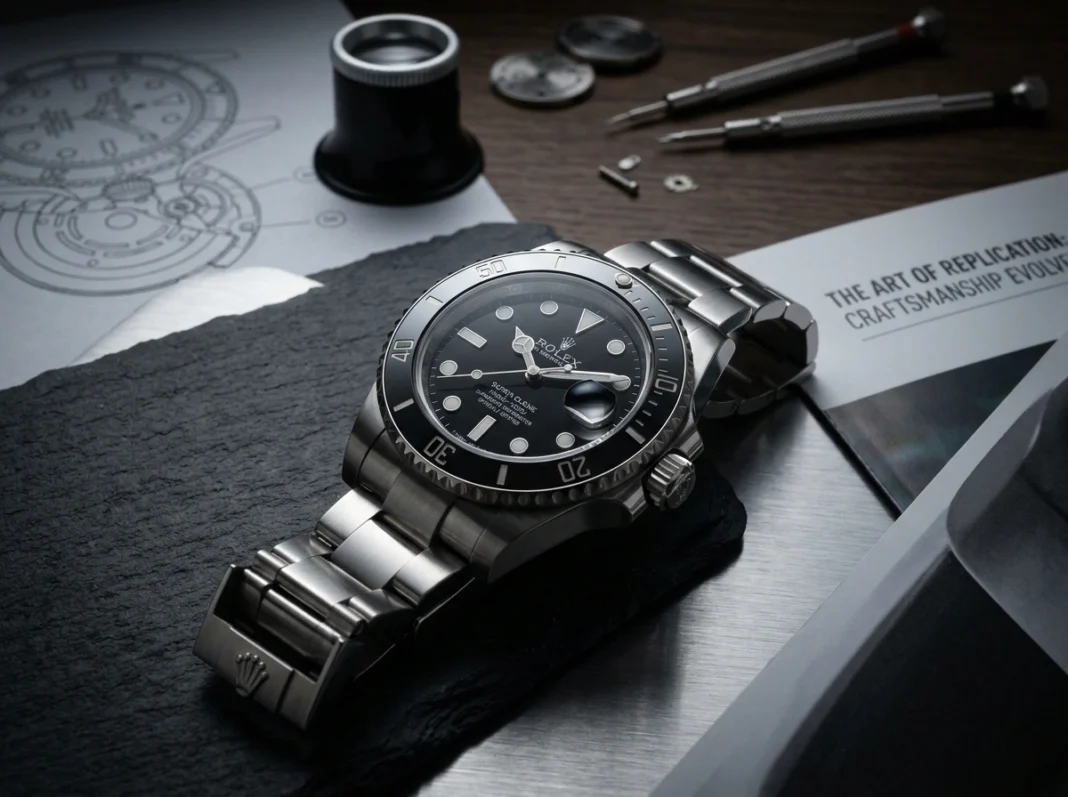
Few watch brands carry the prestige of Rolex. Its blend of heritage, engineering, and design has made it one of the most admired names in horology. That admiration also fuels a fascinating parallel industry: the world of high-quality timepieces inspired by Rolex models. Over the years, the craftsmanship behind these watches has changed dramatically. What once looked like crude imitation has grown into a niche obsessed with detail, accuracy, and quality control.
This article looks at how that craftsmanship has developed across several key areas, including materials, movement imitation, finishing, and manufacturing precision. Understanding this progress helps explain why enthusiasts pay such close attention to the difference between a true homage piece, a basic replica, and the more advanced builds many collectors discuss today.
From Rough Replica to Refined Detail
The earliest copies of luxury watches were simple. Manufacturers focused on shape and a recognizable dial, with little concern for accuracy. A casual glance might pass, but anyone familiar with the real thing could spot the difference instantly. Cases felt light, crowns were poorly aligned, and printing on the dial often looked uneven.
These early efforts fall squarely into the basic replica category. They prioritized speed and low cost over fidelity. Bracelets rattled, lume glowed weakly, and water resistance was usually nonexistent. For a long time, this was the standard expectation.
The shift came as demand grew for closer attention to detail. Buyers wanted pieces that not only looked the part but felt substantial in the hand. That pressure pushed makers to study the originals far more carefully and to invest in better tooling. The result was a steady move away from rough approximation toward genuine craftsmanship.
Better Materials Make a Difference
One of the clearest signs of improvement lies in materials. In the early days, cases were often made from cheap alloys that scratched easily and discolored over time. The weight felt wrong, and the surface lacked the depth of polished steel.
Modern builds tell a different story. Many now use 316L or even 904L stainless steel, the same grade Rolex famously uses for its corrosion resistance and bright finish. Sapphire crystal has largely replaced soft mineral glass, offering far better scratch resistance. Ceramic bezels, once impossible to reproduce convincingly, now feature smoother color and cleaner engraving.
Even smaller components have improved. Crowns, pushers, and gaskets are machined with tighter tolerances. Lume application has become more precise, producing an even glow that mimics the look of the genuine article. These material upgrades reflect a broader commitment to closing the gap between inspiration and execution.
Movement Imitation and Mechanical Progress
Perhaps the most impressive evolution involves the movement. A watch can look perfect on the outside, but the heart of any timepiece is what drives the hands. Early copies often used unreliable mechanisms that drifted badly and failed quickly.
Today, attention to movement quality stands at the center of the conversation. Some builds use cloned movements designed to mirror the architecture of Rolex calibers, including the rotor layout, bridge shape, and balance assembly. Others rely on well-regarded automatic movements that offer dependable timekeeping and a smooth sweeping seconds hand.
Accuracy has become a selling point rather than an afterthought. Enthusiasts now discuss beat rates, power reserve, and date alignment with the same seriousness collectors apply to authentic watches. This focus on mechanical fidelity marks a major leap from the throwaway mechanisms of the past. For those who study this niche closely, the level of detail found in a modern rolex super clone shows just how far movement engineering has come.
Finishing: Where Craft Truly Shows
Finishing is where skilled work becomes obvious. A polished case is one thing, but the transitions between brushed and polished surfaces reveal the maker’s true ability. On lower-quality pieces, these transitions look blurry and inconsistent. On higher-end builds, the lines are crisp and deliberate.
Dial work has also advanced significantly. Applied indices now sit cleanly, printing is sharp, and color matching has grown more reliable. The cyclops lens over the date, long a weak point, has improved in both magnification and positioning. Bracelet finishing receives the same care, with proper brushing, solid end links, and clasps that close with a satisfying click.
These details matter because they define the overall experience. A watch that feels well finished delivers a sense of quality that goes beyond a quick visual match. The growing emphasis on finishing demonstrates how this niche has matured into something resembling genuine craftsmanship.
Manufacturing Precision and Quality Control
Behind every well-made watch sits a manufacturing process. The biggest change over the years has been the move toward consistency. In the past, two watches from the same batch could vary wildly in quality. One might align perfectly while another arrived with crooked hands or a misaligned bezel.
Improved tooling, CNC machining, and tighter assembly standards have reduced this variation. Quality control checks now catch problems before products reach buyers. Gaskets are tested, movements are regulated, and bezels are checked for proper alignment. This focus on repeatable precision separates serious makers from those still producing low-effort goods.
The result is a more predictable product. While variation still exists, the overall standard has risen considerably. Buyers can expect a level of consistency that simply did not exist in earlier years.
Homage, Replica, and the Spectrum Between
It helps to understand the language used in this space. A homage watch openly takes design inspiration from a famous model without copying its branding. These pieces celebrate a look while carving out their own identity. A replica, by contrast, aims to reproduce a specific watch as closely as possible, including its name and logo.
Between these two ideas sits a wide spectrum of quality. On one end are quick, low-cost copies. On the other are carefully engineered builds that rival the originals in feel and function. The craftsmanship discussed throughout this article applies mainly to that higher end, where makers treat accuracy as a craft rather than a shortcut.
This distinction matters for buyers who want to understand what they are getting. Knowing the difference between a homage design and a faithful reproduction helps set realistic expectations and shapes how each piece is judged.
Looking Ahead
The trajectory is clear. Each generation of these watches has narrowed the gap between imitation and authenticity. Materials have improved, movements have grown more reliable, finishing has sharpened, and manufacturing has become more consistent. What began as rough copying has evolved into a niche that values precision and detail.
This evolution shows no sign of slowing. As tooling improves and knowledge spreads, the standard continues to climb. For enthusiasts who follow this corner of the watch world, the craftsmanship story remains one of steady, impressive progress.
Whether you view these timepieces as homage tributes or detailed replicas, one fact stands out: the level of skill involved has grown far beyond its humble beginnings. The watches of today reflect years of refinement, study, and dedication to getting the details right.